The first failure
Carrying something nobody hears
Spend enough years carrying something nobody seems to hear, and it gets harder to listen yourself. What feels obvious to you starts to feel like proof that everyone else is missing the point.
And the people closest to the work, the ones taking in the most grief and anger and exhaustion, usually have the least room to put any of it down. Outreach workers. Shelter staff. Nurses. Neighbors who have watched the same block for twenty years.
Before a city can make sense of itself, it has to settle its nerves. When people feel safe, disagreement stops being a threat and becomes a way of seeing each other.
I have spent about fourteen years in these blocks, most of it responsible for buildings inside them. Four years in SoMa now, four before that running two buildings in the Tenderloin, four in SoMa before that. Earlier still, two years delivering water into what felt like every building in this city, which teaches you quickly who actually keeps a place standing. What that leaves you with is less expertise than a particular set of memories, and a habit of listening to people who are each right about something and cannot hear each other.
For a while now I've been asking people in the Tenderloin the same question. Not what do you need, since everyone already thinks they know the answer to that. The question is: if you had a home tomorrow and every physical need taken care of, what's the first thing you'd do?
I expected to hear about things. Almost nobody says a thing.
They say they want to call their family. They say they want people to stop looking through them. They want to stop being written off. They want to sleep without keeping one eye open. They want a shower, though the way they say it, a shower has nothing to do with plumbing.
I've asked my housed friends the same question. They answer with things.
The gap between those two answers is most of what this proposal is about. We're still collecting these conversations and we're keeping the recordings, with permission, and we'll say how many there are when there are enough to count.
The second failure
An archive without a memory
San Francisco keeps an extraordinary record of what it does, but no coherent, navigable public record of why.
The reasoning isn't missing. It's scattered across hearings, staff reports, public comment, correspondence, recordings. You can find the vote in a minute. Finding what people actually believed at the time, what they were looking at, what they were afraid of, and what they expected to happen takes weeks, if you can do it at all.
A few years pass, the people change, and the same arguments start over.
The point isn't to make the city agree. It's to make it harder for the city to forget what it disagreed about.
The shape of the record
Eight things worth keeping
Tap any step.
-
Who held a position. On the surface you see agency, role, and date, because institutional positions recur across decades and that's the pattern worth seeing. Underneath, the named speaker, the exact words, and the original document stay attached. We're not trying to make institutions sound like they speak with one continuous voice. "Supportive housing without services will not hold."
-
The evidence they were actually looking at. Usually a specific report, a specific year, a specific caseload, rather than a general appeal to what everyone knows.
-
The thing they were trying to prevent, in their own words. Fear is often the most honest part of a public position and the first part to vanish from the summary.
-
A prediction concrete enough to be checked later. Not everyone will make one. Those who do are doing the city a service, and the record should treat it that way.
-
The decision as adopted, which is the one part the existing archive already keeps well.
-
Observed outcomes from public data, at one year, three years, five years. Reported as measurements, not as verdicts.
-
What moved underneath the decision while it was being carried out. A pandemic. A funding cliff. A plan built differently than it was written. Without this node, every prediction that didn't hold looks like bad thinking.
-
What we still don't know. Most civic questions don't resolve, and a record implying they do is a record people will learn to distrust. This is the node that keeps it from becoming a scoreboard.
What we want to build
Two kinds of infrastructure
A network of places across San Francisco where people doing hard work can come together, recover, and listen. Not one room. Different neighborhoods need different things, and the people who live in them should decide what that looks like. Some will be small and quick to open. Some will take years and serious construction. What holds across all of them is that access stays free for the people carrying the city's heaviest burdens.
A public record of civic reasoning. Not a scoreboard, and not an attempt to settle who was right. A prediction that doesn't come true is not proof of bad thinking. Circumstances change, plans get built differently than they were written, the world is uncertain. The record is released to the city at no cost and stays public whatever happens to us.
Putting these two things in one place is a much older idea than it sounds.
For something like a thousand years, people around the Mediterranean who were sick or troubled travelled to healing sanctuaries. The most famous was at Epidaurus in Greece. You didn't arrive and get treated. You arrived, and first you washed. Then you rested, sometimes for days. Then you slept in an inner chamber called the , where you were expected to dream, and the dream was the point.
And on the walls of that place were the , stone inscriptions left by people who had come before. What they arrived with. What happened. Anyone could read them, and people did, for centuries.
Rest and record, in one building. The idea is that old, and we would only be putting it back.
No single building is the project. Each one is an instrument. People come through, organizations convene, conflicts surface, things get tried, and what's learned goes into the record. Leases end and administrations change. The record stays public. Over time it becomes something the next person doesn't have to start over without.
How the parts fit
Five things, in plain words
Everything here is one of five very old human functions. If you remember nothing else from this page, remember these.
- WelcomeThere is room for you here. Food, warmth, somewhere to sit that is not a waiting room, and someone at the door who is glad you came.
- NoticeSeeing what is actually here rather than what we assume. Listening, storytelling, immersive work, and refusing to let people become invisible.
- CareTending what we have been given. Bodywork, food, cleaning, repair, maintenance, of the building and of the people in it.
- ConnectCarrying knowledge across boundaries it does not normally cross. Between the street and the upper floors, the neighborhood and city hall, the practitioner and the funder.
- MakeWhat exists is not the only thing that could exist. Building things together, and keeping what was learned so the next group inherits it.
A twelve-year-old can follow that list, and so can a city official, and so can someone sleeping in the doorway outside. We wrote it that way on purpose.
The same five, from the operating side
Each of the five has an operational twin. One is what a visitor experiences; the other is what has to be running for that experience to be possible. As above, so below.
- Welcome → RestNobody rests anywhere they do not feel safe and wanted. Welcome is the precondition, rest is the thing itself, and everything downstream depends on it.
- Notice → InquiryYou cannot sit inside a question you have not noticed. Noticing comes first; inquiry is what you do once something has your attention.
- Care → FormGiving something form takes care in both senses, the craft and the tending. Artists make the unresolved question inhabitable, which is careful work.
- Connect → EncounterConnection is the arrangement; encounter is what happens inside it. Getting people who do not share a world into the same room, with nobody required to give up what they know.
- Make → Memory and discernmentMaking is where the loop closes. What gets built and what gets recorded feed the judgment about what helps, what harms, for whom, and at what dose. Then that changes what gets made next.
Read as a loop it runs rest, inquiry, form, encounter, memory, discernment, and back to rest. In practice people arrive at any point, and plenty never move past the first.
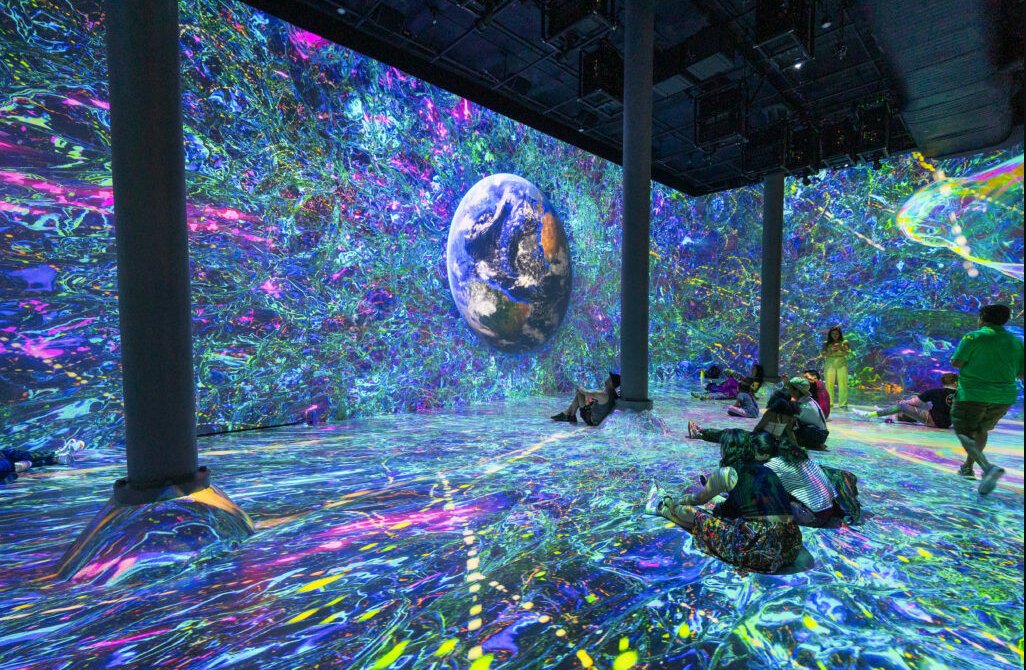
Watch what people do in a room like this: they sit down on the floor, and they stay. Strangers end up beside each other facing the same thing, which is a rare arrangement and a good starting condition for talking to someone you don't agree with.
That is the register we mean, pointed at what a neighborhood is actually arguing about instead of at spectacle. On a boarded storefront at 6th and Market, the exterior version costs a projector and asks nothing of anyone walking past. Philosophy made participatory, playful and intergenerational, the way the Parlor of Ideas already does it, is what the inquiry side looks like done well. Dataland and Submersive show what the medium can already do.
What actually happens
One afternoon
The pieces are easier to describe than the thing itself, so here is one plausible afternoon.
- Someone walks in off Market Street. There's tea, and somewhere to sit that isn't a waiting room.
- In the middle of the floor is a question, given form by an artist, so that you enter it rather than read it. Today it asks when a neighborhood stops being the same neighborhood.
- Four or five people end up in front of it who would not otherwise be in a room together. A facilitator keeps the inquiry moving without steering it toward agreement.
- Before leaving, anyone who wants to can leave something behind: a changed mind, a disagreement, an experience, a prediction, or a question that stayed open.
- That goes into the record, with their name on it or without.
- Next month's gathering starts from what this one found instead of from nothing.
And someone comes in who needs something else entirely. Let's be accurate about what a ground-floor storefront can do. It is not a clinic and it is not a shelter, and claiming otherwise would set someone up to be turned away at the moment it mattered. Direct care, meaning bathing, wound care, and rest that lasts more than an afternoon, belongs in nodes built and staffed for it, and that's part of what the network is for.
What this site can do is not hand someone a photocopied list of addresses. Someone who works here knows the neighborhood, walks them to the place they actually need, and checks back the following week. A referral is a piece of paper. This is somebody going with you, and not forgetting you afterwards because you were difficult to be around.
And whatever someone comes in for, they owe this project nothing in return. No story, no survey, no testimony, no artwork, no data. Care is not a transaction and it is not a way of harvesting material. If we ever get that backwards, the thing has become the opposite of what it claims to be.
An invitation
Why artists, and why now
A lot of artists working in immersive media, animation, games, VFX, and film have had a hard few years. Some lost jobs to generative systems. Some are back at work for less, competing with more people for fewer roles. We're not going to pretend a good cause is compensation for that.
But something else is happening at the same time. As machines make images abundant, the scarce thing becomes judgment about what is worth making at all: what should be experienced together, whose experience should shape it, what question a work should hold open rather than answer, and what a place deserves to remember.
There is a civic role in that, and not much precedent for it. An artist here isn't producing assets. They build the thing that lets a hard question be entered by people who disagree about it. A room about addiction that doesn't tell you what to think about addiction. An installation where competing explanations of the same block coexist in space. A Tenderloin story placed beside city testimony from twenty years earlier.
What we want the terms to be, and what we'd have to build to make them real: commissioned rather than speculative work, artists named prominently, rights retained wherever possible, clear consent and provenance, paid residencies, a share where ticketed work earns, direct relationships with communities and researchers rather than through a client, room to make things that wouldn't survive a commercial brief, and a path for work made here to travel.
None of that funding exists yet. That's what we're trying to build, and we'd rather say so than promise it.
How a coalition would work
Nobody folds into anybody
Organizations that already do this work well should stay exactly what they are. The project lives in the overlap, not in a new entity that absorbs everyone. Coordination doesn't require consolidation.
This is a description of how we think it should work, not an announcement. No organization named or implied anywhere on this page has agreed to anything. Several conversations are underway and we'll say who when there's something to say.
The bet we're making
What would have to be true
Stated plainly, so it can be argued with:
If people have more capacity to rest and settle, and if hard questions can be entered rather than only argued about, and if people who rarely share a room inquire together, and if what they find is kept rather than lost, then organizations and communities should get better at seeing disagreement accurately, learning from what was already tried, and changing course.
All of that is a hypothesis, and each link in it could fail. Starting small is how we find out which one does.
What the first pop-up would actually test
Not whether the whole theory holds. We want the smallest observable thing that changes because this exists.
Do people who wouldn't normally speak to each other stay in a shared inquiry, or leave? Afterward, can participants state each other's positions accurately, and is that better than before? Does rest beforehand change willingness to engage? What kinds of contributions turn out to be worth preserving, and which are noise? Do people come back? Do partner organizations find the space useful enough to use it again without being asked? Does an artwork change the quality of the conversation, or just draw a crowd? Can the record hold complexity without making people defensive about it?
These are questions, not finalized metrics. Some will turn out to be the wrong things to measure.
What we'd measure at scale
Utilization and repeat visits, broken out by who's actually coming. How many people were in the room at once who wouldn't otherwise share a room. Burnout and turnover among partner-organization staff who use the space, which those organizations already track.
And one measure specific to the claim: the gap between what each group believes the others want and what those others say they want, before and after. That gap is what we say we can close, so it should be possible to show whether we did.
We want a research partner holding us to this rather than grading ourselves.
Go deeper
The parts that need more than a paragraph
Isn't immersive work about hard lives just trauma porn?
The serious version of this objection is about structure, not subject. A viewer feels deeply for twelve minutes, gets the moral credit, and leaves, while the person whose life was used gets nothing and controls nothing. That critique is correct wherever it applies, and it says nothing about whether hard stories should be told.
So we answer it structurally. Four questions, answered in writing before anything is made: who holds the rights, who gets paid, who decides where it screens, and can the teller pull it back.
There's a second answer, about craft. Work that promises you've become someone else is making a promise it can't keep. It mistakes point of view for embodied experience, as Lisa Nakamura puts it, and the broken promise is what feels obscene. Work that marks the seam, that returns you to your own body knowing you did not live this, is doing something else. It leaves you with I can't know, and now I can see the shape of what I can't know, rather than now I know.
We'll say the other half plainly too: people do sometimes act better after understanding something they didn't before, and there's experimental work suggesting immersive perspective-taking can shift attitudes. The distinction we're drawing isn't between knowing and not knowing. It's between a knowing that closes and a knowing that stays open.
Where AI fits, and where it doesn't
Much of the anger about AI among artists is about value capture, not technology. Work was used without consent or payment and then used to undercut the people it came from. Any invitation that opens by explaining AI's potential is an invitation from someone who benefited.
So the terms come first, and the same consent scope that covers storytellers covers artists.
In the record, the useful role for a model is narrow and unglamorous: reading thousands of pages of hearing transcripts and flagging what looks like a claim, a fear, or a prediction, for a person to check. It is not deciding who was right. Nothing here needs a machine to have an opinion.
The bathhouse, and why it isn't in the headline
First, credit where it's due. Shelters have showers. Some gyms and YMCAs have opened their locker rooms to people who are unhoused. Mobile hygiene programs have put thousands of showers on the street. Those partnerships took real work by people who cared, and they matter.
But a shower is hygiene, and hygiene is not rest. They're different things and we've quietly agreed to pretend one covers the other.
Here's my own version of this, since it's the reason I believe it. I spent years guarding without knowing I was doing it. It took me a long time to be able to let a stranger's hands anywhere near me for a massage, and longer still to sit in a hot spring and feel whatever it is that lets go in your chest when you finally stop bracing. That sound you make. I'd call that baseline: the ordinary condition a person should be able to return to. It costs a fortune. In this city it's sold as luxury, which is a strange thing to do with a starting point.
Now think about who most needs to get back to baseline and can least afford it. The SRO manager. The medic on their fourth overdose call of the shift. The street cleaner who has been dealing all week with conditions most people would refuse to look at. We pressure-wash the sidewalks constantly and never tend to the people doing the washing.
Bathing infrastructure paired with wound care, clinical partners, and somewhere frontline workers can actually stop is, we think, the strongest long-term form of the first kind of infrastructure. It's also capital-heavy, permit-heavy, and wet, which is why it's phase two rather than the opening move.
I'm going to massage school for this, not to become a massage therapist. I want to be able to give it away. That's a personal commitment, not a business plan, and the professional version will need licensed practitioners and a real budget.
We would rather earn it. Prove that the lighter version works, measure it, then build the thing the evidence asks for.
Who the first site is actually for
It's for the people who absorb this city's hardest conditions as a job, every day, and have nowhere to put it down.
The manager of an SRO full of people trying to get clean, working a building that dealers treat as a convenient storefront. The first responder who just worked another overdose in a room the size of a parking space. The Urban Alchemy worker who has cleaned up things this week that most San Franciscans have arranged never to see. These people are not a hard-to-reach population. They're at work right now, three blocks away, and nobody has built them anything.
That's who we start with, alongside the residents, neighbors, and city workers who are arguing about the same blocks and rarely in a room together.
It is not a crisis-response site. Someone in acute crisis needs services this storefront will not have, and putting them in a room with a school group would fail everyone in it. This is not squeamishness. It is what happens when a space pretends to a capability it does not have.
Which doesn't mean those perspectives are absent. A story can be in the room before the person is ready to be. That is what the immersive work is for: a bounded container, entered on purpose, where someone's experience can be encountered without anyone being put on display or put at risk. The people whose experiences these are get paid, named, and keep control over where their work goes.
The exterior is free and publicly accessible, and asks nothing of anyone walking past. And whoever staffs the threshold inside is doing a real job that takes real training, and we intend to hire it from the neighborhood.
Won't a public record make officials stop saying anything?
It might, if we build it carelessly. If people expect to be scored, they'll retreat into language that can't be checked. It is a real failure mode and we would rather name it than be caught by it.
What we'd do: lead with agency and role on the surface while keeping named sources attached underneath. Keep prospective participation voluntary, while the retrospective layer works entirely from public record. And build the distinction between a prediction that didn't hold, circumstances that changed, and a plan never implemented as written in from the first day, because those three get confused constantly and the confusion is what makes people defensive.
We are not first
People who have already done parts of this
Every piece of this has been built by someone, somewhere, and several were built here. What we're proposing is to connect these functions into one learning system in one place.
Lava Mae / LavaMaeˣ
Doniece Sandoval converted retired Muni buses into mobile showers after learning how few public shower stalls existed for thousands of unhoused people. It later became an accelerator publishing a replication toolkit so others could build their own.
DemonstratesDignified bathing as a service, and a durability model where what lasted wasn't the buses.
Theaster Gates & Rebuild Foundation
An artist bought a derelict bank on the South Side and turned it into an archive, a library, and a gathering place, treating cultural memory as the thing worth housing.
DemonstratesArtist-led placekeeping and civic archive as the same building.
vTaiwan and Pol.is
A public process for surfacing where large groups actually agree and disagree, used on genuinely contested national questions. It maps the shape of disagreement rather than forcing a vote.
DemonstratesCollective sensemaking that doesn't require consensus.
Horst Rittel and the wicked-problems tradition
Rittel argued that planning problems aren't solvable the way engineering problems are, and built IBIS, a way of recording issues, positions and arguments so a design conversation could be inherited rather than repeated.
DemonstratesPreserving the structure of reasoning. Our eight nodes are a descendant.
The Citizens' Assembly
Randomly selected citizens spent months with evidence and with each other on the country's most divisive questions, and produced recommendations that moved national policy.
DemonstratesOrdinary people deliberate well given time, information, and good conditions.
The public sauna
Communal bathing is ordinary social infrastructure there rather than luxury wellness, with a substantial research literature attached to it.
DemonstratesBathing normalized as public rather than premium.
The organizations already holding this corridor
Glide, St. Anthony's, Code Tenderloin, Urban Alchemy, the Tenderloin Museum, Miracle Messages, Gray Area and others have been doing the actual work for years or decades. We are not proposing to replace any of it.
DemonstratesLocal capability, trust, and continuity already exist. The gap is shared infrastructure.
Where this comes from
References
Sorted by what kind of thing each one is. A framework isn't evidence, and a book that shaped our thinking isn't proof that a civic intervention works. A project about preserving how people know what they know should be careful about this on its own page.
The full reading list
Evidence
Empirical studies and evaluated programs.
- Peck, Seinfeld, Aglioti & Slater, Putting yourself in the skin of a black avatar reduces implicit racial bias, Consciousness and Cognition 22(3), 2013, 779–787. Counter-evidence to our own caution, and we take it seriously.
- Laukkanen T, Khan H, Zaccardi F & Laukkanen JA, Association between sauna bathing and fatal cardiovascular and all-cause mortality events, JAMA Internal Medicine 175(5), 2015, 542–548. Roughly 2,300 men from the Kuopio Ischaemic Heart Disease Risk Factor Study, followed a median of about 21 years.
- Laukkanen T, Kunutsor S, Kauhanen J & Laukkanen JA, Sauna bathing is inversely associated with dementia and Alzheimer's disease in middle-aged Finnish men, Age and Ageing 46(2), 2017, 245–249.
- The limits of both: observational cohorts, all middle-aged Finnish men, and people who sauna four times a week may differ from people who don't in ways the models can't fully remove. Suggestive, not settled. We cite them as reason to measure, not as proof.
- A further caution: polyvagal theory is widely used in somatic practice and contested in the research literature. We use it as vocabulary, not as evidence.
Precedent
Things that actually exist or existed.
- Lava Mae / LavaMaeˣ, San Francisco, 2013–.
- Rebuild Foundation and the Stony Island Arts Bank, Chicago.
- vTaiwan, Pol.is, and Decidim (Barcelona).
- The Citizens' Assembly of Ireland, 2016–.
- The Finnish public sauna; Japanese sento; the Hungarian thermal baths.
Framework
Design and conceptual frameworks we're building on.
- Rittel & Webber, Dilemmas in a General Theory of Planning, Policy Sciences 4, 1973, 155–169.
- Kunz & Rittel, Issues as Elements of Information Systems, Working Paper 131, University of California, Berkeley, 1970. The origin of IBIS.
- Jeff Conklin, Dialogue Mapping: Building Shared Understanding of Wicked Problems, Wiley. The practical descendant.
- James Fishkin, When the People Speak: Deliberative Democracy and Public Consultation, 2009.
- Elinor Ostrom, Governing the Commons, 1990.
- Philip Tetlock & Dan Gardner, Superforecasting, 2015.
- Matthew Lipman and the Philosophy for Children tradition; the community of inquiry.
- Bruce Perry, the Neurosequential Model. Regulate, relate, reason, in that order.
- SAMHSA, Concept of Trauma and Guidance for a Trauma-Informed Approach, 2014.
Critique
Arguments against what we're doing, which we'd rather engage than route around.
- Lisa Nakamura, Feeling good about feeling bad: virtuous virtual reality and the automation of racial empathy, Journal of Visual Culture 19(1), 2020, 47–64.
- Kate Nash, Virtual Reality Witness: Exploring the Ethics of Mediated Presence, Studies in Documentary Film 12(2), 2018.
- Ramirez, Elliott & Milam, What it's like to be a ___: why it's (often) unethical to use VR as an empathy nudging tool, Ethics and Information Technology 23, 2021.
- Susan Sontag, Regarding the Pain of Others, 2003.
- Sherry Arnstein, A Ladder of Citizen Participation, 1969. On consultation that functions as placation.
Intellectual lineage
Sources that shaped the design. Not evidence, and we're not presenting them as such.
- Jacques Derrida on the trace and différance. A trace is not a presence; it points past itself.
- Keith Basso, Wisdom Sits in Places, 1996.
- Ivan Illich, Tools for Conviviality, 1973.
- Tyson Yunkaporta, Sand Talk, 2019.
- Donald Kalsched, Trauma and the Soul, 2013.
- Marie-Louise von Franz, Puer Aeternus, and James Hillman's writing on the senex–puer pair. Behind the note on boundlessness and containment.
- Dunne & Raby, Speculative Everything, 2013.
- The Asklepian sanctuaries at Epidaurus and elsewhere, and the iamata inscriptions. Rest and record in one building, for several centuries.
Where it starts
A first site, and pop-ups
The Frontier Tower ground floor at 6th and Market, roughly 7,700 square feet on a corner lot and currently boarded, is a strong candidate for the first site, and there's an open call for proposals with a partnership structure flexible enough to make it work.
That proposal is written up in full as The Hearth, including what it costs at three different funding levels.
It may not be that building. If it isn't, the work doesn't change; we run pop-ups in the Tenderloin and build outward from what they teach us. We're saying that plainly because a proposal that depends on one lease is a fragile proposal, and because the building's owners should choose what's right for them rather than what's convenient for us.
Those boarded windows are, for now, an asset. Projection doesn't need glass. An exterior that responds to the people walking past it, where your own movement changes what is on the wall, is the cheapest and most public thing we can build, and it asks nothing of anyone who encounters it.
Dates that are real
What happens when
- Aug 31Frontier Tower proposal dueGround-floor call for proposals, 995 Market
- SeptemberPop-up runsThe first working version, and where the evidence comes from
- Sep 11Boundless SF registration closes5 p.m. Pacific
- Oct 9Boundless SF application due5 p.m. Pacific
- Nov–DecParticipatory reviewEvery applicant evaluates four others against the same four criteria
- Mar–Jun 27Up to seven finalists selected
- Jun–Aug 27Finalists receive technical and financial supportAnd submit a comprehensive proposal
- Fall 2027Up to three awardees, $10–50M eachImplemented over as much as five years. Which means the first year is funded some other way
A note on the word "boundless"
Every city has a bias, and San Francisco's is toward the new. The launch, the pivot, the prototype, the next thing. That bias is the reason anything gets built here at all, and it's why people keep coming.
Its shadow is that very little gets finished, almost nothing gets remembered, and every few years the same lesson has to be learned again by people who don't know it was already learned. Boundless energy without anything holding it doesn't produce more; it produces the same beginning over and over.
Depth psychology has a pair of names for this: the eternal youth who can imagine anything and won't land, and the old man who remembers everything and won't move. Neither one is healthy alone, and a culture that treats one as virtue and the other as obstacle will keep re-enacting the same year.
What San Francisco is short of is not vision. It is containment, which is not a criticism of ambition but the condition for it. Both halves of this proposal are the holding kind: a record that remembers what we already tried, and rooms with walls where a person can actually stop. Boundless is what becomes possible once something holds.
What we need
Specific asks
Artists working in immersive media
Projection mapping, VR and mixed reality, spatial sound, interactive environments, games, film, performance, participatory work, and things that don't have names yet. Both the exterior wall and the interior.
Organizations already doing this work
We are not proposing to solve anything you are already solving. We are proposing a floor you can operate on, with a threshold and a commons in between. Partner rather than beneficiary.
A lead organization and a founding coalition
Someone has to hold and administer a large multi-year public-benefit award and be accountable for it. Several kinds of entity can do that, and we have not chosen. Everyone else stays who they are and can be funded through subgrants or contracts. If you want in, we need to know while there is still time to register.
People who know the archives
Anyone who has worked inside the Legislative Research Center, Planning's hearing records, or the Budget and Legislative Analyst's office. The retrospective layer can start immediately and needs nobody's permission. It just needs people who know where things are.
Operators, which is not what I am
My part in this is the concept, the coalition, and the standard. Running a floor is a full-time job with real accountability and it needs somebody whose whole attention is on it. The first site is recruiting a general manager, and we are looking first among people who already know this corridor from the inside.
A research partner
Someone to hold the measurement honest, publish the method, and tell us when we're wrong.
Owners of empty ground floors
Anywhere in the city. Pop-up terms, short commitments, revenue share. An empty storefront is a site.